

Wineries put enormous care into how they are perceived and almost none into how they are found
The whole argument, read aloud, for the drive to the vineyard. Same figures, same sources.
What winery SEO actually is
Winery SEO is the work of making your winery the answer to questions people are already typing. Not your name. The questions.
Almost every winery in America has done the first part and skipped the second, and here is the clearest way I know to show you what that costs.
Malbec gets 16,000 searches a month at a difficulty score of one.
Difficulty runs zero to a hundred and estimates how hard it is to break into the top ten results. A one means the door is standing open.
Viognier is a zero.
What people type when they’re deciding what they like
| Varietal | Searches / month | Difficulty |
|---|---|---|
| Cabernet Sauvignon | 71,000 | 31 |
| Sauvignon Blanc | 63,000 | 5 |
| Pinot Noir | 55,000 | 8 |
| Chardonnay | 43,000 | 23 |
| Merlot | 21,000 | 9 |
| Riesling | 18,000 | 7 |
| Malbec | 16,000 | 1 |
| Zinfandel | 11,000 | 46 |
| Sangiovese | 11,000 | 7 |
| Tempranillo | 9,800 | 8 |
| Syrah | 6,400 | 6 |
| Viognier | 6,100 | 0 |
| Grenache | 5,200 | 12 |
| Cabernet Franc | 4,900 | 5 |
| Red Blend | 4,400 | 4 |
| Petit Verdot | 2,600 | 4 |
| Every row at difficulty 12 or below adds up to 223,400 searches a month – from people trying to work out what they like before they spend forty bucks finding out the hard way. | ||
Three of those are genuinely contested. Cabernet Sauvignon at 31 is the biggest term in wine and gets fought over accordingly. Chardonnay at 23 is the same story. Zinfandel at 46 is the surprise of the group.
Set those three aside for now. I’m going to come back to them, and they don’t end up where you’d expect.
Everything else on that list sits at twelve or below, and those rows add up to 223,400 searches a month from people trying to work out what they like before they spend forty bucks finding out the hard way.
In most industries a difficulty score of one means nobody is searching for it. Here it means people search constantly and nobody has bothered to answer them.

The reason it’s still sitting there is not that it’s hard. It’s that wineries have decided it’s beneath them.
Seventy-six million people
There are 76 million American adults who drink wine, and together they spend north of $115 billion a year doing it. They search all the time.
They search for what to pour with a rib roast, whether the bottle they liked at a restaurant is worth ordering by the case, how Willamette Valley Pinot differs from what comes out of Walla Walla, and whether it’s legal to ship a case to a brother-in-law in Texas.
Somebody answers every one of those questions and gets paid in attention for doing it. Almost none of those somebodies are wineries.
It’s Wine Spectator, it’s Wine Folly, it’s a Reddit thread, and it’s a retailer in New Jersey with a blog who will happily sell that reader somebody else’s wine.
What the DTC number is actually measuring
Direct-to-consumer sits at roughly 8% of total US wine sales by value, and everybody in the industry quotes that figure.
But DTC is a bucket, and it’s worth knowing what’s inside it.
It holds tasting room sales, wine club shipments, phone orders, and website orders, all mashed together. Wine club alone is about 39% of it.
Strip out the members and the visitors, the people who already found you, and look at what’s left. Strangers who found you online and bought something.
Before COVID, that piece was 2 to 3% of most wineries’ DTC sales. Not of total sales. Two to three percent of the eight percent.
Winery websites were brochures with a checkout button, and there was no particular reason to think otherwise at the time.
Hold onto that number. Within a few weeks it went past thirty percent, and what happened in between is the useful part.
What actually happened in 2020
Something changed in those years and it had almost nothing to do with wine.
People changed their minds about what they were willing to buy without touching it first. That sounds like a small thing and it was enormous.
Grocery stores that had been dabbling in online pickup went all in on it inside of a few weeks. Curbside became a normal thing to do on a Tuesday. Amazon, already the size of a small country, got bigger and faster.
Ecommerce hit a second plateau, and this one stuck. People found out they could order almost anything from almost anyone, and it would show up, and it would be fine.
Wineries were part of that too. Tasting rooms closed, the people who would have driven out bought online instead, and for a stretch there those websites were doing real work.
Then things opened back up.
Most of the industry read that bump the way you’d expect anybody to read it. It was a substitute. People bought online because they couldn’t come see us, and now they can come see us again, so let’s get back to the real business.
There’s some truth in that. Just not enough of it.
Everybody else read it the other way
The grocery chains didn’t treat curbside as a stopgap. They treated it as a beachhead and kept building, and now ordering off the Safeway app isn’t pandemic behavior, it’s just Thursday.
Something came along with that, and it’s the part worth paying attention to.
People got comfortable trusting businesses they buy from online. Not just the giant ones either, once the habit was formed it transferred.
That trust didn’t stay in the grocery aisle. It went everywhere, wine included.
Online wine sales in North America are projected to grow 5.6% a year over the next five years, which is more than double the 2.5% growth of the wine market overall. Wine already accounts for 53% of online alcohol sales on this continent.
The channel is growing faster than wine itself is.
The channel is growing faster than wine itself isWine ecommerce platforms got good. That’s not the missing piece.
This part surprises people, because the tooling is genuinely there now.
WineDirect, Commerce7, OrderPort. Real ecommerce platforms built specifically for this business, with club management and compliance and reporting and analytics that would have been science fiction fifteen years ago.
If you’re on one of them, you already own a capable storefront. Most wineries are.
Here’s the thing nobody mentions while they’re selling you one.
A platform will take an order beautifully. It won’t go out and find the person who places it.
That part is content, and structure, and the slow accumulation of authority on a domain you own. No platform produces it for you, and switching from one to another won’t move a single new customer in your direction.
That’s the whole story, and it was the story in 2020 as well. The businesses that grew through it weren’t the ones with the best checkout. They were the ones people could find.
Which means the good news is real
I want to be straight with you, because the headlines around this industry have gotten grim and a fair amount of that is earned.
But the wineries doing this work are winning, and the numbers aren’t ambiguous about it.
Roughly 40% of premium producers with proportionally higher DTC revenue are still growing, while 35% of wholesale-focused brands went backward by 5.6%. Same market, opposite outcomes.
Smaller wineries are outperforming larger ones on wine club growth, because the intimate version of this business translates better to a younger buyer than the corporate version does.
And a boxed wine brand called Gratsi grew total DTC revenue 76% in a single year by building an audience online instead of waiting on tasting room traffic. Boxed wine. Seventy-six percent.
None of those are stories about somebody getting lucky. They’re stories about somebody deciding the internet was a real channel and then treating it like one.
The tomato problem
The standard objection to all of this is that wine is experiential, that people need to taste it and see the place and shake the winemaker’s hand before they’ll commit.
I’d have believed that in 2015. It doesn’t survive contact with a grocery app.
People now buy their tomatoes online. They let a nineteen-year-old shopper they have never met walk the produce aisle and pick out what goes in their salad, every week, having decided the convenience is worth more than the squeeze test.
If a person will outsource picking their own produce, the idea that they must personally visit a hillside in Walla Walla before buying a bottle is not a law of consumer behavior. It’s a story the industry tells itself about why the website doesn’t need work.
Most people who come to know you will never walk in
This is true of nearly every business on earth, and wine keeps treating itself as the exception.
The overwhelming majority of people who will ever hear your name, form an opinion about you, and potentially hand you money aren’t going to set foot on your property. That’s not a failure of hospitality, that’s arithmetic, and it applies to restaurants and law firms and bike shops in exactly the same way.
The difference is that a bike shop knows it. Wine has built almost its entire direct sales apparatus around the assumption that the relationship starts with a visit.
Which is why the channel is capped by your parking lot
Winery DTC shipments track visitor traffic, and tasting rooms and clubs together make up more than half of the average winery’s total sales.
So when tourism dips, when gas gets expensive, when your region has a bad fire season and the smoke sits in the valley for three weeks in August, direct sales fall. There is nothing you can do about it from inside the tasting room.
You built a business that can only sell to people who came to you, and the number of people coming has been drifting down since 2021.
And yet some of them are growing 22%
In that same shrinking market, top-quartile wineries grew revenue 22% while the median winery went flat and the bottom quartile fell 13%. That’s a thirty-five point spread inside one industry in a single year.
Which means the market is not the variable. Something those wineries are doing is the variable, and whatever it is, it doesn’t require a person to drive out and park.
The customers are changing under you
Millennials are now 31% of US wine drinkers and have passed Baby Boomers at 26%, while Gen Z climbed from 9% to 14% in two years. That group doesn’t discover wine from a print score.
They are entering the decade of their lives that involves houses and dinner parties and weddings and gifts, which is the decade where people start spending real money on wine.
They find things by typing a question, and increasingly by asking an AI, and whoever answered the question gets the sale.
 Watch · 1 of 1
Nobody is answering the questions your customers are already asking
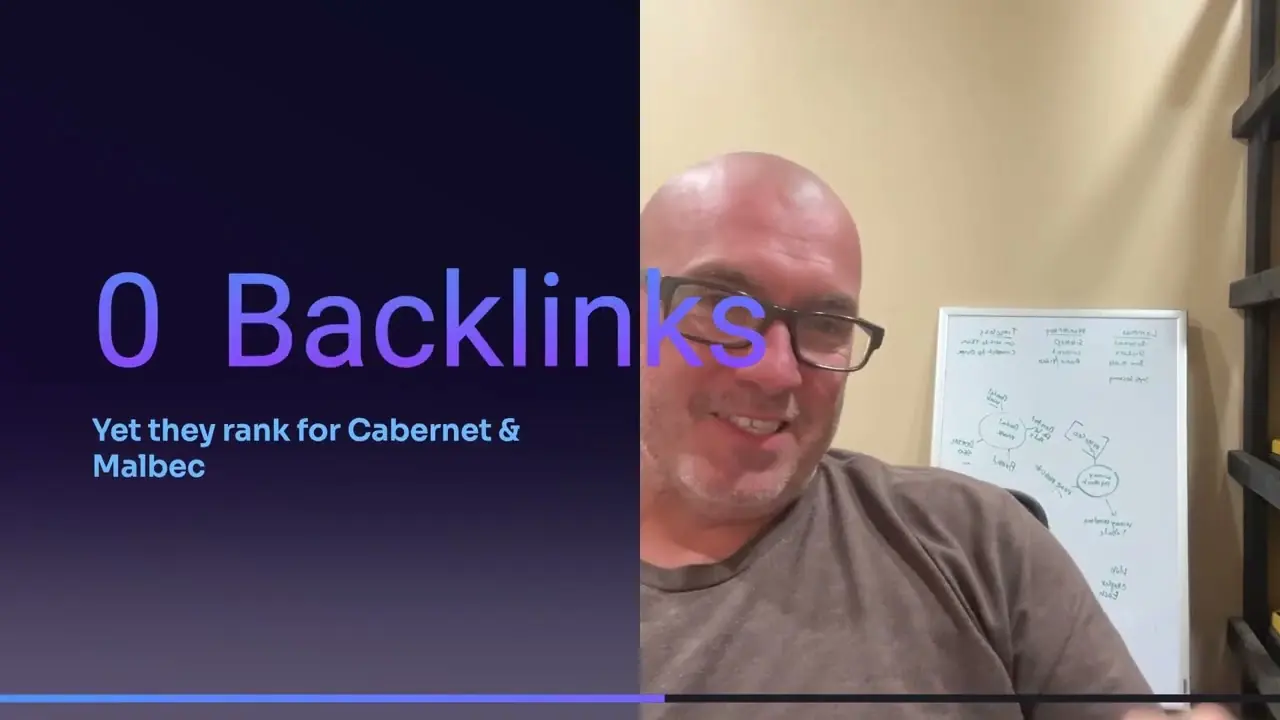
The short version of this page for anyone who’d rather be told than read: where the 223,400 monthly searches actually are, why the difficulty scores are so low, and what a varietal library looks like when a winery builds one. Hosted, captioned, no autoplay – it costs you nothing until you press play. Or skip it and get the audit.
Wineries don’t lose winery SEO, they forfeit it
Losing means you entered and got beat.
What actually happens is that eleven and a half thousand American wineries fight over the same three channels while an entire acquisition channel sits open with nobody standing in it. The tasting room, the club email, and a magazine score.
All three are crowded, all three are expensive, and all three require you to already be somebody.
Search is the one place where a small operation in a small appellation can beat a large one on effort alone. It’s also the place nobody’s working.
“But we already rank”
You probably do, for your own name, and that’s worth saying out loud because it’s step one and plenty of wineries haven’t nailed even that.
Somebody types your winery into Google and there you are. Good. That’s the floor.
The catch is who’s typing it. Everybody searching your name already knows you exist, because somebody told them, or they had a bottle at dinner, or they drove past the sign on the way to somewhere else.
You didn’t acquire that person. You just didn’t lose them.
There are three tiers to this and most wineries only own the first.
- Your name.Easy, and you should absolutely have it. Nobody discovers you here.
- Your region and your grapes.Willamette Pinot, Napa Cabernet, Virginia wineries, Walla Walla reds, Sonoma Chardonnay. This is where discovery actually happens, and it’s genuinely competitive because it’s where the traffic is.
- The map pack.That block of three businesses with a map that sits above the regular results whenever somebody searches something local. Anything with “near me” attached, or a place name, or typed on a phone in your county.
So when somebody tells me their site ranks fine, I believe them. They’re describing tier one.
Tiers two and three are where the people who’ve never heard of you are standing.
Local SEO for wineries and the map pack
Tier three deserves its own treatment, because it’s a different game with different rules and it’s the one closest to your parking lot.
A large share of local traffic ends in the map pack before anybody scrolls down to the regular results. Somebody types wineries near me from a hotel in Walla Walla on a Saturday morning, sees three names and a map, and picks one. The rest of the internet may as well not exist for that search.
It runs off three things. Your Google Business Profile, how close you are to the person searching, and how well-known Google thinks you are.
The first is the only one you control outright, and it’s the one nobody works. Claiming it isn’t the same as running it. Hours that are actually current, including the ones that change during harvest. Photos added more than once. Products loaded. The question section answered by you instead of by a stranger guessing on your behalf.
Reviews sit inside this too, and they’re not just a reputation matter. They’re a direct input into where you place, which means asking for them is search work and not only hospitality work.
The distance part you can’t change. But it’s worth knowing that the map pack redraws itself for every searcher based on where they’re standing, which is why your ranking looks different from your phone at the winery than it does from a laptop in Seattle. Checking it from your own tasting room tells you almost nothing.
This is the piece of winery SEO with the shortest payback, and it’s usually where we start.
Why they skip it, and this part is not their fault
A winery doing a million two a year is not short on people.
There’s a vineyard manager and a winemaker. There’s a wine club manager, a tasting room lead, a GM holding the whole thing together, and probably somebody handling events.
Marketing gets done, and some of it gets done well. Somebody owns the club emails, somebody owns the release calendar, somebody keeps Instagram alive, and none of that’s being neglected.
What doesn’t exist anywhere on that org chart is a person whose actual discipline is search.
The website wasn’t a function, it was a project. It got scoped, it got built, it got launched, somebody was proud of it at the time, and then it quietly became nobody’s job.
The club manager isn’t going to pick it up, because her numbers are retention and reorders and she’s judged on those. The GM isn’t going to pick it up, because he’s looking at visitation and allocation and a harvest budget.
So the site sits there, technically owned by everyone and actually owned by no one, doing whatever it was built to do in 2019.
That’s not a failure of effort. It’s a gap in the org chart, and it’s the most common one in this business.
Winery website design and the gap between designer and developer
Search doesn’t live on the design side, and it doesn’t live on the development side. It lives in the space between them, which is exactly why it goes missing.
On one end you have a designer in love with simplicity and beauty.
Everything is spare and quiet, the whitespace is generous, and the copy stays short because long copy would spoil the composition. It’s stunning work.
It also means the entire frame of the site is built around brevity, where the aesthetic is relied upon to tell the brand story.
There’s no template anywhere on it that can hold a three thousand word piece without looking broken.
Which matters more than it sounds, because thorough content is the thing that actually wins these searches.
So when somebody finally proposes writing the real page, the answer is that it doesn’t fit. Putting it in means disrupting the design, and nobody wants to be the one who wrecks the site everybody just paid for.
The site didn’t fail to rank because somebody forgot to optimize it. It was built in a shape that made ranking impossible, and that call got made before a single word was written.
On the other end you have a developer reaching for an H1 every time there’s a big piece of text.
Six of them on one page, because six headlines needed to be the same size. The tag is doing the job of a font size instead of a structure, and a machine reading that page learns nothing about what it’s for.
Using markup to tune your designer’s style choices crashes recklessly into SEO. Hence the need for a middle player who understands technical SEO.
There’s a second version of this that’s harder to see, and it’s worth a brief explanation.
Years ago Wix was notorious for something called browser-side rendering. The page didn’t actually assemble itself until it landed on your screen.
The alternative is server-side rendering, where the page shows up already built. That’s what Wix uses now.
Google handles either one. But it has pretty clearly shown a preference for the second, and the reason is mechanical rather than philosophical.
A page that has to be assembled goes into a queue and gets built whenever there’s spare capacity, which might be a few minutes and might be a couple of weeks. One firm tracking this found somewhere between five and fifty percent of newly published pages still had content missing from the index two weeks after going live.
You published your site, and Google hasn’t taken a moment to look at it yet, let alone decided where it ranks among its peers.
Several of the newer AI site builders, the ones that hand you a finished website in about four minutes, generate exactly this kind of page. It’s a genuinely fast way to get something live.
It also appears to run directly against sound SEO practice, and that doesn’t come up in the demo.
Neither of them is being negligent. The designer built what he was asked to build, and the developer shipped something that works.
The discipline that actually matters sits between their two job descriptions, and nobody was ever hired to stand there.
Deep dive · /winery-website-design/Winery website designBuilding a site that can hold three thousand words on Syrah without looking broken.The swampy foundation under most winery websites
The other reason this is hard to see: the damage is done before a single word gets written.
A lot of wine sites are built on a template somebody bought and modified. Out of the box, those make structural choices on your behalf, and they make them for visual convenience rather than for machine legibility.
None of it is visible to you. The site looks beautiful and you paid a fair price for it.
But every piece of content you add later sits on a foundation that can’t carry it. You could write the best tasting room page in Washington and it will go nowhere.
At which point you reasonably conclude that SEO doesn’t work for wineries, and you tell your neighbor that, and he believes you.
Your winery photography is doing nothing for you
Wineries take some of the best photographs in American business, which makes what happens to them hard to watch.
Harvest at dawn with the fog still down in the rows. Punch downs, the barrel room, bottling day, and the dog who lives in the tasting room and has more personality than most of the staff.
Almost all of it gets uploaded raw and never touched again.
What about the filename? Does it say what the photo actually is, or is it still DSC_4471.jpg the way it came off the card?
What about the alt text, the line that describes the image to anybody who can’t see it, machines included? What about a caption underneath, which is one of the most-read pieces of text on any page?
What about the structured data around the photo, telling a search engine what it’s looking at and who made it?
Are the images sized for the screen they’re landing on, or is a phone downloading a file built for a thirty-inch monitor?
Are they compressed, so the page loads before somebody gives up on it?
Or is it the situation I see most often, where a photographer you like and pay well hands over a folder of gorgeous files, and somebody drags them onto the site, and that’s the end of it?
Google runs an entire search vertical on images, and AI systems assembling answers about your region are reading image data as a signal.
Your photography is among the most valuable assets you own, and most wineries hand it over with the tags cut off.
What Google is actually trying to do, and what that means for wine SEO
Strip the jargon out and what Google is after is simple. Somebody asks a question, and Google tries to hand them the most accurate and most useful answer that exists.
That’s the whole goal. One sentence.
Simple isn’t the same as easy, though, and I want to be clear about that before we go any further.
Working out what your customers actually search, in the words they actually use, at the point in their thinking where they’re using them, is real research. It takes time and it takes tools and there’s no shortcut through it.
Restructuring a site so a machine reads it the way you intend is technical work, and it’s the kind that goes wrong quietly when it’s done by somebody guessing.
Writing three thousand words on Syrah that an actual human being finishes reading is hard. Most people can’t do it, including most people who write for a living.
The goal is one sentence. The work behind it is a discipline, and anybody who tells you otherwise is about to hand you a checklist.
So the real question for your winery is not how to game a ranking system. The question is whether your site is genuinely the best available answer to something a human being actually typed.
Most winery sites don’t answer questions at all, because most winery sites aren’t built to answer. They’re built to declare.
I went and read eight winery websites
Instead of telling you what a winery website looks like, I opened a batch and read them.
Eight wineries across five regions, picked to be spread out on purpose. Sonoma, Walla Walla, Willamette Valley, Napa, Texas Hill Country, and Virginia. Two more blocked me outright, which is worth a sentence of its own: if an automated request can’t read your site, that includes the systems assembling AI answers about your region.
They say the same thing.
Not similar things. The same thing.
The Napa winery leads with being a Napa winery. The Willamette winery leads with being a Willamette winery. Texas Hill Country leads with Texas Hill Country, and Walla Walla leads with Walla Walla.
Underneath that, in nearly the same order every time: Our Estate. Our Wines. Our Story. Our Mission. Visit Us. Join the Club. Upcoming Events. Welcome to [winery name].
That isn’t a caricature. It’s the actual list, pulled off live sites, repeating across thousands of miles and six growing regions.
Every one of those pages was built to differentiate. And they all differentiate in exactly the same way.
Your story, your estate, your winemaker, your philosophy, your commitment to the land. Those are supposed to be the things that set you apart from the winery down the road.
But the winery down the road has all six of them too, in the same order, under the same headings, with a photograph of their cute shih tzu.
They differentiate themselves by not being different.
And honestly, that part is fine
None of this is a criticism of your homepage.
Your homepage is supposed to be about your brand. That’s its job, it should keep doing it, and I’m not going to tell you to put “How Many Servings Are In A Bottle Of Wine” on your front door.
You sell your first thousand cases. Google works out that you’re a winery in a particular place. Somebody types your name, or your name and the word tasting room, and there you are.
That’s genuinely an accomplishment. Plenty of wineries never get that far, and most of the eight I read have.
So keep it. Keep all of it.
But think about who else is typing
Somebody wants the best syrah in walla walla and has no particular winery in mind.
Somebody’s trying to work out what makes willamette pinot different from sonoma pinot before they spend sixty bucks finding out.
Somebody’s standing in a store holding a bottle of Cabernet Franc, typing what is cabernet franc with one thumb.
Somebody’s searching walla walla wedding venues with a date already picked and a number in mind.
Somebody wants walla walla wineries with estate vineyards, would love yours, and has never heard your name in their life.
Not one of those people can search for you. They don’t know you exist. That’s the entire problem in one sentence.
So where do they land?
Not on your homepage. Your homepage answered a question that was addressed to you by name, and none of these people addressed anything to you.
This is why I say wineries put enormous care into how they are perceived and almost none into how they are found. Those are two different jobs, and only the first one got done.
So I went looking for the pages that could catch those people
If the homepage belongs to the brand, and it does, then the answering has to happen somewhere else on the site. So I went a level deeper on the same eight wineries.
Four of the eight have no blog, journal, or guide section at all that I could reach from the homepage. Not a thin one. None. There’s nowhere in the house for that kind of page to live.
Of the four that do have one, one is entirely announcements. Press release, vintage release, impact report, a magazine mention. Every word of it written for people who already follow the winery.
Two are mixed. Mostly staff introductions and estate news, with a few real pieces scattered in, like cellaring tips or a list of sustainable certifications.
One is genuinely doing the work. Road trip guides, a tasting weekend itinerary, seasonal pairing tips, and a piece on what makes their sub-appellation one of the strangest growing areas in wine. That’s written for somebody who hasn’t visited yet.
The thing nobody has written
Go back to those varietal numbers for a second, because the people typing those words aren’t industry. They’re consumers, standing in a store or sitting on a couch with a phone, trying to make a decision.
Nobody is meeting them there yet. Not the appellation associations, not the trade groups, and above all not the wineries who grow the exact grape being searched. Not a single one of the eight websites has a varietal library.
Not even the winery currently sitting on page one for Malbec. That page exists, it ranks, and it didn’t even surface in their own blog index when I went looking for it.
They wrote it once, years ago, and moved on. It’s still out there working.
What the winners actually look like
I went and read the results, because a difficulty score means nothing until you see who is actually sitting there.
So start with the hard one.
Search Cabernet Sauvignon. 71,000 searches a month at a difficulty of 31, the most contested term in this entire category. At position six you’ll find Silver Oak, a Napa winery, with a blog post titled “7 Things You Should Know About Cabernet Sauvignon.”
That page has a URL rating of zero and not one backlink pointing at it, and it pulls around 440 visits a month.
And inside the AI Overview at the very top of those same results, Google is citing La Crema’s varietal guide. A winery’s own explainer, being read aloud by the machine to people who will never see a search result at all.
Two wineries, on the hardest term in the category, with nothing pointing at either page.
Now search Malbec, difficulty 1, and at position six you’ll find Freemark Abbey with a page called “What is Malbec?” Also zero backlinks.
Three wineries, no links between them, all on page one
| Winery | The page | The term | Where it sits | Links to that page |
|---|---|---|---|---|
| Silver Oak Napa · domain DR 61 | “7 Things You Should Know About Cabernet Sauvignon” | Cabernet Sauvignon · 71,000/mo · KD 31 | Position 6 | 0 backlinks · page UR 0 |
| La Crema Sonoma | Their own varietal guide | Cabernet Sauvignon · 71,000/mo · KD 31 | Cited inside the AI Overview, above the results | Nothing pointing at it |
| Freemark Abbey Napa · domain DR 44 | “What is Malbec?” | Malbec · 16,000/mo · KD 1 | Position 6 | 0 backlinks |
That one you’d expect. The first two you wouldn’t.
Three wineries, no links between them, all on page one of terms that get tens of thousands of searches a month.
What the difficulty score is actually measuring
Now come back to those three contested grapes, because Zinfandel is the one that explains the whole metric.
Zinfandel scores 46, higher than Cabernet Sauvignon at 31, on a fraction of the volume. That looks wrong until you read the page.
Wikipedia sits there with 8,361 links pointing at it. Wine Folly has 7,091. Jancis Robinson has 2,160. A site called The Grape Grind has 10,835.
That’s the entire explanation. Difficulty scores measure the backlink wall in front of a term, and encyclopedia pages have been collecting links for twenty years.
But look at who else is on that same page.
Backlinks pointing at the top pages for “zinfandel” · KD 46
- The Grape Grind DR 28 10,835
- Wikipedia 8,361
- Wine Folly 7,091
- Jancis Robinson 2,160
- winemadeeasy DR 30 · position 5 zero
- wineonsale DR 41 · position 8 zero
Two pages with nothing at all are in the top ten anyway. That is what a difficulty score of 46 is describing.
A site at DR 30 sitting at position five with zero backlinks. Another at DR 41 at position eight, also zero. The Grape Grind itself is only DR 28.
So Zinfandel isn’t harder than Cabernet. It’s a page where the encyclopedias have enormous link profiles and pages with nothing at all are getting in anyway.
Difficulty is a weather report, not a wall.
It tells you what the link barrier looks like and says nothing about whether a genuinely better page can walk past it.
One more thing to know before anybody writes that particular page. The shopping results on Zinfandel are Barefoot, Sutter Home, and Beringer, which is White Zinfandel, the sweet pink stuff. That’s a different drinker than the one looking for old-vine Sonoma Zin, sharing one search term.
Sorting out which of them you’re writing for is the research, and it’s exactly the kind of thing a difficulty score will never tell you.
What winery SEO pages are actually named
They get named after the question they answer, and the naming is deliberately unglamorous.
What Is Malbec. Seven Things You Should Know About Cabernet Sauvignon. How Many Servings Are In A Bottle Of Wine. How Long Does An Open Bottle Last. Can You Ship Wine To Ohio. What Makes The Rocks District One Of The Strangest Places In Wine.
Every one of those is somebody’s real question in their own words. All of them are real pages, and several are ranking right now.
None of them is clever. None would survive a branding meeting, and I’ve come to think that’s precisely why they’re still available.
Your homepage says who you are to people who already know to ask. These pages go out and find the ones who don’t.
Notice what Freemark Abbey didn’t have to do. They didn’t reinvent the site, didn’t touch the brand pages, didn’t hold a meeting about repositioning.
They wrote one page that answered a question. It went out and found strangers while the homepage kept doing exactly what homepages do.
So you don’t have to choose. What’s missing isn’t a better homepage, it’s a different kind of page entirely.
Which is the whole point
If nobody ranked on these terms, a winery could reasonably say it can’t be done and go back to the tasting room. Instead there are three existence proofs and about eleven thousand other American wineries who didn’t try.
And it isn’t a link game, which is the part that should get your attention. Those pages won with nothing pointing at them, meaning nothing was bought, nothing was negotiated, and no PR firm was involved.
One honest caveat, because you’ll find it yourself if you go looking. Silver Oak’s domain is a DR 61 and Freemark Abbey’s is a 44, built over decades of being written about. That authority is doing some work here and I’m not going to pretend otherwise.
But the pages themselves have nothing. Nobody built links to them, nobody promoted them, and a DR 28 site is sitting in the top ten on Zinfandel with the same story.
Somebody sat down and wrote the thing well enough that Google preferred it.
We ran this play before anybody was calling it one
Some years back we were doing the web work for Basel Cellars here in Walla Walla, and partway through that engagement we started writing real pages about the actual grapes.
Not tasting notes, and not the vintage release copy every winery in America produces on a schedule. Proper pages on Cabernet Sauvignon and Syrah and Merlot, what they are, where they came from, why one drinks like a fistful of blackberries and the other one like a campfire.
The rankings moved. We got to page two on Syrah and page three on Cabernet Sauvignon for a small Walla Walla winery with no link profile and no budget behind it, at a time when nobody in this industry was talking about any of it.
Basel Cellars has since been sold and that site is gone.
We were early. The door is still open, which says more about this industry than it does about us.
What a varietal library actually takes
Silver Oak has exactly one varietal page, and it’s Cabernet Sauvignon, and Silver Oak is a Cabernet house. They wrote about the grape they were already famous for.
Their best performing blog post isn’t even that one. It’s a piece explaining how many servings are in a bottle of wine, which pulls almost twice the traffic.
So the obvious conclusion is go write a page for every grape you farm. That conclusion is right and it skips the part that decides whether it works.
- First, you have to find out how people actually ask.
Not how you’d phrase it. Not how a sommelier would phrase it.
Somebody searching Malbec might type what is malbec, or is malbec sweet or dry, or malbec vs cabernet, or what does malbec taste like, or best malbec under 20. Those are five different pages, or one page with five sections, and knowing which is a research question with a real answer.
Guess wrong and you write three thousand lovely words that nobody was looking for.
- Second, you have to decide how the pages relate to each other.
A library isn’t a pile. Your Malbec page, your Syrah page, your appellation page, and your tasting room page all have to know about each other and link to each other in a way that makes sense to a person walking through them.
That structure is what tells a search engine which of your pages is the important one on a subject, and it’s the piece almost nobody gets right because it’s invisible when you look at the site.
- Third, you write.
Genuinely good, genuinely long, genuinely useful, in a voice that sounds like a person who has actually farmed the grape. That last part is the one thing on this list that no agency and no software can fake for you.
- Fourth, the page has to do something at the bottom.
Somebody who just read three thousand words on Malbec is warmer than most people who walk into a tasting room, and the majority of winery blog posts end with nothing at all. No bottle, no club, no next step, no reason to stay.
Your Malbec page should put your Malbec in front of them. Your shipping page should say plainly that you ship to their state. That’s the difference between traffic and revenue, and it’s the cheapest part of this to get right and the one most often skipped.
And it isn’t twelve pages. It’s twelve varietal pages, plus the questions underneath each of them, plus the appellation pieces, plus the practical ones about shipping and storage and serving.
That’s a body of work. It’s the reason the opportunity is still sitting there, and it’s also the reason it stays valuable once you’ve built it.
The shipping questions are the closest thing to a sale
Somebody typing can you ship wine to Ohio is not browsing. They have a card out and a specific obstacle, and the answer decides whether they buy.
You already know the answer for your winery, because you had to. Your compliance provider tracks it, your platform enforces it at checkout, and somebody on staff can recite which states are a headache and why.
That knowledge is sitting inside an internal system doing nothing for you publicly. It’s the rare piece of content where the research is already finished and the only missing step is writing it down somewhere a stranger can find it.
It ages well, too. The rules move slowly, and a page that’s right stays right for years while it quietly collects people who are ready to spend.
Why it’s still available
I don’t think anybody skipped this out of laziness. I think two things happened.
One, it’s a real project and it competes with harvest, release, and a club that needs attention this week.
Two, there’s a quiet feeling in this business that a big plainspoken explainer about Merlot doesn’t belong on a site meant to convey a certain kind of quiet luxury. It doesn’t fit the blend.
I understand that instinct and I’d push back on it gently.
You’re one of the few people on the internet who has actually grown the thing. Explaining it isn’t beneath the brand, it’s the most credible thing the brand could possibly do.
“Can’t I just use AI for this?”
You can, and I’d think less of you if you didn’t ask.
Sit down tonight and a model will write you two thousand words on Malbec, and some of it will be decent. That part of this job got cheaper and it is not going back.
Here’s the part it can’t do.
It won’t tell you that Malbec pulls 16,000 searches a month at a difficulty of one while Petit Verdot pulls 2,600 at a four. It has no way to know that.
The table further up this page didn’t come out of a model. It came out of a keyword tool, and somebody had to go pull it, filter it, and read the actual search results to confirm the numbers meant what they appeared to mean.
Ask an AI what your customers search for and it will guess. It might guess close, because it has read an enormous amount of the internet and it has a decent sense of how people talk.
But close isn’t the same as knowing, and you can’t build a plan on a guess that sounds confident. Confident guessing is the single most expensive thing about these tools.
The distance between “write something about Malbec” and “write about Malbec because sixteen thousand people a month are asking and nobody in this industry has answered them” is the whole strategy.
One of those is content. The other is a decision with evidence underneath it.
So yes, this means tools, and tools cost money. It also means somebody who knows how to read what the tools say, because the numbers lie in specific and predictable ways if you take them at face value.
Zinfandel is the example. A model reading that a term scores 46 would tell you to avoid it, and a person reading the actual page would see three sites with no links sitting in the top ten.
AI search reads your winery site the same way, only stricter
When somebody asks ChatGPT what to drink with lamb, or asks Perplexity which Washington wineries ship to Ohio, the model is assembling that answer out of indexed, structured, readable content. Clean structure, honest headings, real answers, and facts stated plainly enough to be lifted and cited.
If Google couldn’t parse your site then an AI can’t either. Everything in the foundation is the price of admission here too, which is why I’m not going to sell you a separate AI service. It’s the same work.
There’s one real difference and it’s worth understanding, because it changes the math on whether this is worth doing.
Ranking puts you on a page of ten options and the person still has to pick you. A citation puts your name inside the answer itself, before any picking happens, and it doesn’t require you to be first at anything. La Crema is not the top result for Cabernet Sauvignon. They’re in the answer sitting above it.
The wineries getting cited today didn’t do anything clever for AI. They wrote a clear answer to a common question years ago and are getting paid for it now.
Authority, and the part that’s genuinely unfair
The other half of ranking is authority, which mostly comes down to who links to you, who mentions you, and how long you have been a real presence online.
Napa has that, Willamette has that, and Sonoma has that. They were online early, they’ve been written about relentlessly ever since, and history compounds whether you are paying attention or not.
If you’re newer, or you rebuilt and changed domains, you are starting behind, and I’m not going to sell you a story where that doesn’t matter.
What that head start bought them, though, is complacency. They rank for their own names and their own appellations and they stopped there, which leaves every specific question and every buying moment sitting unclaimed.
You won’t out-age Napa. You can absolutely out-work them.
The press you already earned is worth more than it’s doing
You’ve probably got coverage. Scores, medals, a regional roundup, a festival writeup, maybe a piece in a magazine somebody framed.
That’s real, and it was hard to get.
It’s also worth more than it’s currently doing for you, and that’s a pleasant problem to have because it means there’s value sitting on the shelf rather than value you need to go create.
A mention pulls its weight when it links back to you, gets referenced properly on your own site with the right markup, and points at a page that’s built to rank in the first place. Then it feeds the authority side of this, quietly, for years.
A badge in the footer doesn’t do any of that. Not because anybody did anything wrong, but because nobody ever told you the difference, and there’s no reason a winemaker would know it.
That’s some of the easiest ground to pick up, and it’s usually the first thing we look at.
Why SEO for wineries rewards depth
Wine Spectator can put five hundred words on Malbec and rank with it.
That works because of everything they already have. Twenty-five years online, thousands of sites pointing at them, and a name Google has trusted for a long time.
You don’t have that, and you’re not building it this year.
What you do have is the option to answer the question better than they did. More completely, more specifically, with the things somebody who actually grows the grape knows and a magazine writer doesn’t.
That’s not a consolation prize, it’s the mechanism. Google is looking for the best answer to a question, and “best” is something you can go improve on a Tuesday afternoon.
The big site wins on authority, which takes years. The small site wins on being more useful, which is available to you right now.
What winery SEO services actually involve
- The foundation.
- Structure, heading hierarchy, internal linking, crawlability, speed, schema. Not optional, because everything else sits on top of it.
- The image library.
- Filenames, alt text, captions, compression, structured data. Turning the photography you already paid a professional for into something that works while you sleep.
- The question map.
- Research into how people actually search in your region, for your varietals, at every stage from idle curiosity to card in hand. This produces the content plan and it is not guesswork.
- The varietal library.
- Every grape you grow, covered properly, in your own voice, by somebody who has actually farmed it.
- The boring questions.
- How long an open bottle lasts. What temperature to serve a red at. Whether you can ship to their state. These outperform the prestige topics and they always will.
- Local SEO.
- The Google Business Profile, the reviews, the map pack. Covered further up, and it’s the fastest-moving piece of the lot.
- Events and hospitality.
- Weddings, private dinners, club release parties, venue rental. High intent, local, and almost always buried three clicks deep on a page that was never built to be found.
- Authority.
- Making the press you already earned do real work, and building the relationships that produce more.
- Commerce clarity.
- Making it unmistakable that a stranger can buy from you today, from wherever they live, without ever planning a trip.
How to measure winery SEO
Rankings are a scoreboard, not a result, and any agency reporting only on rankings is hiding something.
What we track is the line from a search to a dollar. Traffic on terms with real buying intent, form fills, club signups, event registrations, and online orders placed by people with no visit history attached to their name.
That last number is the one that matters, because it’s the only one your tasting room can’t produce.
How long it takes, which nobody wants to tell you
This is not a channel that switches on, and anybody promising you page one by spring is describing a different business than this one.
The foundation work shows up fastest, because fixing what’s broken lets Google see pages it was already trying to read. Weeks, not months.
New content is slower. A page goes live, it gets indexed, it sits at position forty, and then it climbs as the site accumulates evidence that it’s worth reading. Call it a few months before a good page is doing real work, and longer on the competitive terms.
The compounding is the point, and the compounding shows up in year two. Every page you published in year one is still working, you’re no longer starting from zero on the next one, and the whole library starts lifting together.
Which is the honest argument for starting now rather than the argument for hurrying.
How to hire winery SEO help, honestly
I’m not interested in keeping any of this mysterious, so here’s the whole menu.
Do it yourself. Buy the tools, learn to read them, and put a real block of somebody’s time against it every week. Wineries do this successfully, and the ones who commit tend to do it well, because nobody knows the wine better than you do.
Budget for the tools at the tier where the data is actually usable, and budget honestly for the hours, because that’s the part that gets underestimated.
If you go that way and want a hand getting set up, ask us. We’ll show you what we’d look at and how we’d read it, and we won’t charge you for the conversation.
Hire somebody. Could be us, could be an agency in your region, could be a good freelancer.
Three questions worth asking whoever you talk to. How would you decide what to write about, and if the answer doesn’t involve data, keep looking. Do you handle the technical structure and the writing, or only one of them, because splitting those across two vendors is how sites end up in the shape we’ve been describing. And what would you measure besides rankings.
For our part, we’re in Walla Walla, we’ve worked with wineries for years, and we know what harvest does to a calendar and why nobody returns an email in late September. We do both halves of the job, and we treat search as a revenue channel with a traceable path to sales rather than a monthly PDF full of green arrows.
Or do nothing for now. That’s a real option, and given everything else on a winery’s plate I understand it.
It’s also the only one of the three with a clock running on it, and that’s the last thing I want to say.
The window on winery SEO is open now
Most of the difficulty scores in that table are in single digits. The three that aren’t have wineries and hobby sites sitting on them with no links at all, which tells you the number was never the real barrier.
The moment a handful of wineries in your region work this out and start covering the questions properly, the bar rises and stays risen. The early ones get the compounding and everybody after them pays retail.
That’s the entire case for winery SEO right now. Not that it’s clever, and not that it’s new, but that it’s sitting unclaimed in an industry where almost nothing else is.
We were early once, at a winery that no longer exists, and I’ve spent a few years since then watching the door stay open longer than it had any business staying open.
It’s still open. That’s the good news, and it’s the whole reason this page exists.